

Written By: Abby Wood
In this article:
- Outside-in Support: Use PR to Draw Media Coverage
- Inside-out Support: Mine Events for Buzz, Content and Leads
- Pro Tips for Smoother, More Engaging Sessions
I’m going to be honest with you: As a marketing strategy, conferences and events seldom offer strong returns, unless you support them well. For clients at Communications Strategy Group (CSG®), I visualize that support coming from two directions. Outside-in support brings media attention to the event and widens its reach well beyond the people in the room. Inside-out support turns conversations, sessions and contacts inside the venue into visibility, content, leads and future event and PR opportunities. If I account for each axis of support, a conference can be a high-ROI strategy for a client. If not, the result is ROWhy, as in, “Why did I let Abby convince me to do that?”
The main problem, as you would expect, is cost. Between registration, travel, booth fees, sponsorship packages and the hours a client spends preparing, a single event can claim a share of a marketing budget that is hard to recoup. But in my experience, the event itself usually does not determine success or failure. Whether an organization is attending, hosting, sponsoring or exhibiting, it’s what you do before, during and after that makes it all worthwhile.
Outside-in Support: Use PR to Draw Media Coverage
Media relations can reach a large audience, and coverage won through PR often comes with a credibility that paid promotion can’t match. Marketers should put those advantages to work in their conference strategy.
My PR work usually goes into high gear one to two months out, when my team or I coordinate with the organizers to get the list of reporters planning to attend. We pitch them interviews with our speakers, executives or institutional partners who will be on site, and lock in those times before the doors open. One-on-one interviews scheduled in advance with speakers, hosts and attendees often lead to deep coverage in high-value publications.
To prepare for those interviews, we usually conduct media training and mock interviews with clients. We also build media backgrounders for secured interviews, which give clients information about the reporter, their outlet, their recent coverage, the main talking points to emphasize, and answers to potentially challenging or “murky-water” questions. I also try to sit in on the interviews when I’m able, either via Zoom or in person.
I also like to expand media outreach beyond the registration list. If a reporter’s beat lines up with the conference theme, I’ll invite them to sit in on the sessions most relevant to their coverage. It’s a win-win: A reporter who covers the future of business education, for example, will find more story material at a session on that topic than they would from scouring dozens of press releases.
Finally, I ask organizers about videographers who can capture sessions and booth activity, since that footage feeds a variety of promotional material we can leverage across channels afterward, which helps maximize the investment. And once the event wraps, I follow up with reporters who attended but didn’t interview with us, sharing our takeaways while the event is still fresh. I often find those relationships pay off at a future event.
Inside-out Support: Mine Events for Buzz, Content and Leads
If outside-in support raises visibility, inside-out support is where most of the return comes from, and it also depends on steps taken before, during and after the event.
Monitor the landscape and draft proposals
Assuming a client wants to speak at a conference, rather than attend or exhibit, they have to be accepted. Strategists at CSG are well aware of the major events within our industries, and constantly on the lookout for emerging ones; we watch event deadlines carefully and craft proposals tailored to industry trends, conference themes and the unique strengths of our clients’ companies.
Build buzz on social media at every stage
In the weeks before the event, attendees, hosts and speakers can post from their social media channels about the session topic, who’s speaking, the booth location and the themes they’re most excited to explore. During the event, I like to have clients provide daily recaps of the best moments, quote graphics and often some quick Instagram Stories with soundbites from sessions. Afterward, recap posts built from the event’s photos and video can share the top takeaways and a deeper reflection on the lessons they learned.
Prepare speakers and exhibitors to capture leads
Many conferences put a QR code on each attendee’s badge. I make sure speakers and booth staff know to scan those codes during sessions and booth conversations so every contact lands in a database that sales and relationship managers can work from.
Package the event into lasting content
CSG follows a principle of content marketing that we call content process optimization. Like thrifty chefs with their prized ingredients, whenever we get our hands on a good piece of content, we look for opportunities to extend its life and use it in as many distinct ways as possible. That can mean adapting its most prominent points to new formats, chopping it up and reusing it on different channels or building on its success with future complementary content.
The principle of creating once and using many times applies to everything that comes out of a conference, so I like to turn session insights, photos and video into shareable assets such as white papers and articles that keep the underlying ideas (and the client’s investment) working for months.
Feed insights into the next proposal
The themes, questions and audience reactions from one event make the next speaking proposal sharper. Proof that a topic already resonated with a live audience helps clients win subsequent speaking sessions.
Nurture contacts toward conversion
Captured contacts go into a three-email nurture stream. The first email goes out right after the event with a recap of the session. The second demonstrates authority on the problem the session addressed, with proof points such as case studies or customer spotlights. The third shifts to conversion by stating the value proposition plainly and inviting the contact to schedule a conversation.
Give sales something to follow up with
Before the event, build a one-pager from the session material. When it ends, the sales team has a ready-made reason to reach out to attendees with a summary of what was presented, rather than a generic “great to meet you” note.
Measure everything
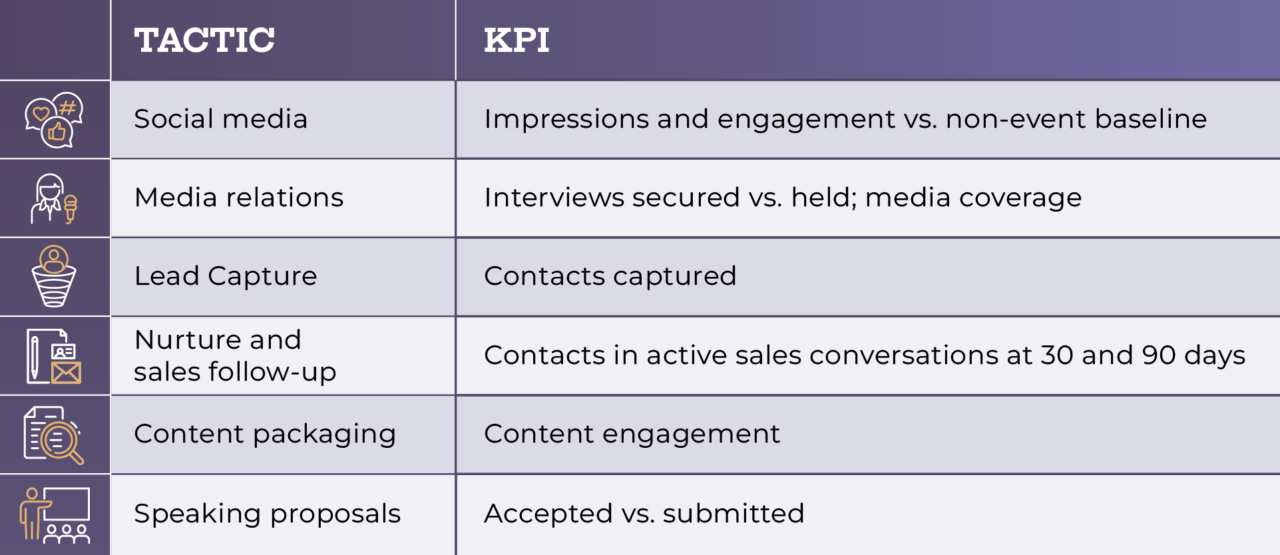
I track KPIs for each tactic in this matrix: social impressions and engagement measured against a non-event baseline, interviews secured versus held, media coverage, contacts captured, contacts that convert to an active sales conversation at 30 and 90 days, content engagement and speaking proposals accepted versus submitted. If you have those numbers, you know what to say when your client asks, “Was it worth it?”
Pro Tips for Smoother, More Engaging Sessions
Give speakers a run of show. I hand every speaker an outline of the session: which topics to cover, in what order and for how long. It keeps the session on pace, and it doubles as the source material for the follow-up one-pager.
Swap the end-of-session Q&A for a QR code. Audience members scan a code and submit questions that reach the speaker right away. Sessions feel more interactive, which audiences respond to well, and no question gets lost because someone forgot it by the time the Q&A slide appeared.
Write the social posts for them. Speakers are busy. Ready-to-use post templates save them time and make it far more likely they’ll share the event on their own channels.
Make Your Next Conference Pay Off
A conference investment pays off when your work extends through the event in two directions: outward to reporters and audiences who weren’t there, and inward to make full use of the contacts, content and conversations the event naturally generates. If your team is planning its next event, CSG can help you build the plan that makes it worth the trip.