

When I walk through a museum, I don’t spend much time worrying about the paintings I love. Loving a painting is easy. You stand in front of it, something happens and, if you’re lucky to have the time, you stay for a while.
It’s the paintings I don’t understand that make me work. When I come across something that leaves me cold, or puzzles me, or seems frankly less interesting than the painting hanging six feet away, I have a habit of asking it a question: Why are you here? Out of the thousands of paintings in storage and the millions that have been painted over the centuries, why did somebody decide that you deserve this particular patch of wall? I’m not trying to challenge the curator to a duel. I assume they know something I don’t, which means my job is to look harder and figure out what it is.
This habit came to mind when I read about a painting that has spent most of the past century without a patch of wall at all. Still Life with Small Game and Grapes on a Gilded Tazza, painted around 1620, belongs to Norway’s National Museum in Oslo. Nine dead birds are arranged across a table alongside grapes, hazelnuts and apricots, with an ornate gilded tazza, a kind of shallow ceremonial cup, rising above them. A fly has alighted on one plump grape.
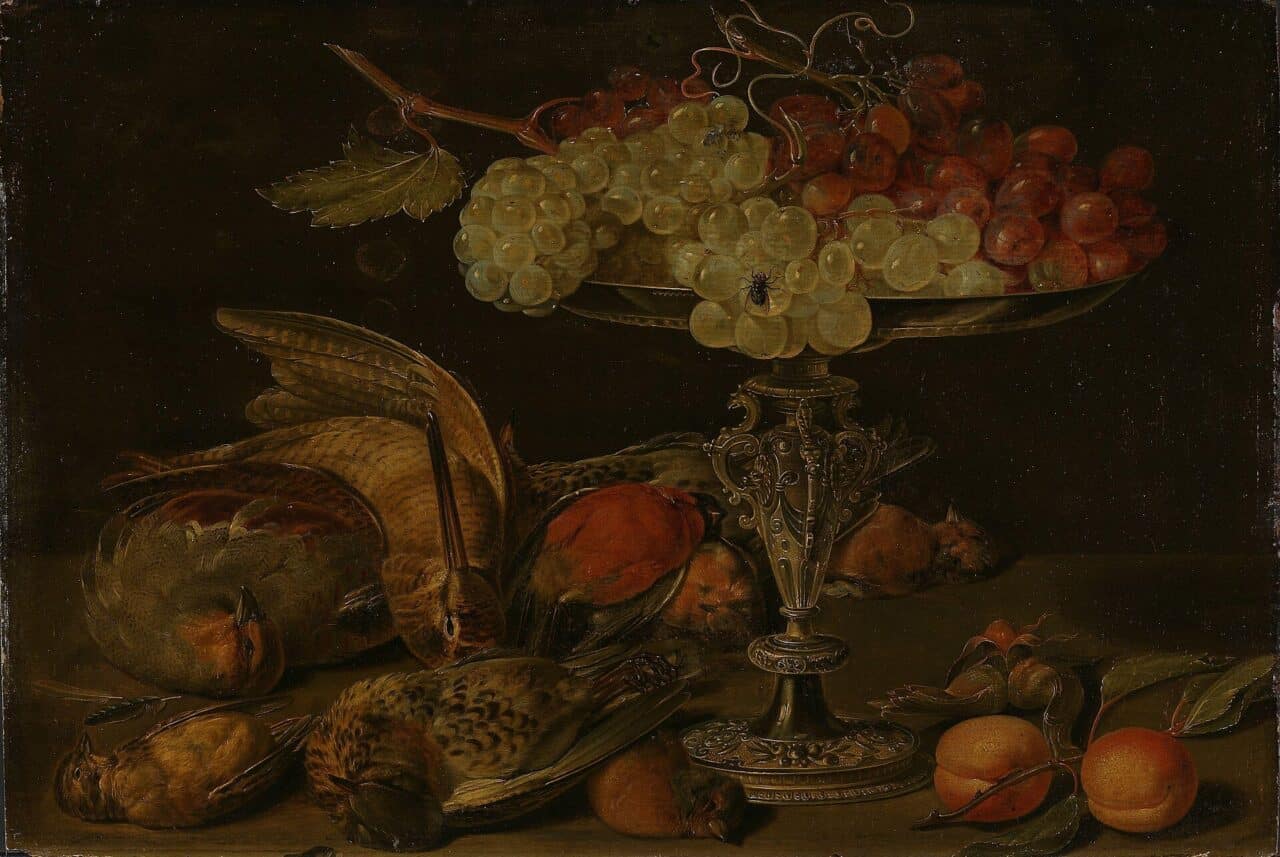
At one point the painting was attributed to Ambrosius Brueghel, a member of the sprawling Brueghel painting dynasty whose work included still lifes. That attribution was rejected in the early 20th century and, eventually, the artist became simply “anonymous.” And anonymous paintings, as you might imagine, have a harder time getting good real estate.
The painting went into storage and largely stayed there until 2022, when curator Cynthia Osiecki encountered it while researching Clara Peeters, one of the earliest artists to specialize in still-life painting and one of the very few women known to have worked professionally as an artist in early 17th-century Europe. Osiecki looked again at that anonymous painting.
A Woman Hiding in Plain Sight
There are enormous gaps in what we know about Clara Peeters, beginning with exactly when and where she was born. She was probably based in Antwerp and appears to have been active from around 1607 to 1621. Almost all her known paintings are still lifes, which may have had something to do with the restrictions placed on women artists at the time. Women generally did not have the same access as men to the study of anatomy and nude models, training that was considered essential for history painting, the genre that carried the greatest prestige.
So Peeters painted things. Fish and cheeses. Bread, flowers and fruit. Game birds. Porcelain bowls, pewter dishes and elaborate silver and gilded vessels. Her paintings can be almost absurdly tactile. The skin of a fish gleams wetly; cheese crumbles at the edge where it has been cut; light skitters across polished metal. Ordinary things share the table with very expensive ones, and everything receives intense attention.
There is something else about her paintings, though, and once you know about it you immediately want to start searching for it: Clara Peeters liked to hide herself in her paintings.
She was fascinated by reflective surfaces, particularly highly polished metal, and in at least eight known paintings, tiny self-portraits appear in the objects she painted. Sometimes there is more than one. Look closely at the shiny bosses of a gilded cup and there she is, impossibly small, reflected in her own still life.
I love this about her. Here is a woman about whom history recorded so little, working in a genre without human figures, repeatedly finding a way to leave a tiny image of herself behind. Osiecki knew these habits intimately because she had spent years studying Peeters, and when she looked at the anonymous Oslo painting she began to recognize them.
The wooden panel came from a supplier Peeters had used. The gilded tazza resembled one that appears elsewhere in her work. The dead birds, grapes and hazelnuts were arranged in ways that echoed other Peeters paintings. Old varnish made some of the finer details difficult to see, but the clues kept accumulating.
But there was a problem: Peeters signed many of her paintings and this one had no signature. Then Osiecki looked at the bottom edge of the panel. It had been damaged by woodworm, in precisely the area where Peeters often placed her signature. Something that initially argued against the attribution began to look considerably less conclusive once somebody examined the painting’s physical history.
And then there were the grapes. Under magnification, Osiecki found shapes on their reflective surfaces that appear to resemble human figures. Centuries of varnishing and conservation have made them too indistinct to declare them miniature self-portraits with certainty, but given Peeters’s documented fondness for putting herself into reflections, they are tantalizing.
Earlier this year, the National Museum formally reattributed the painting to Clara Peeters. Nothing had been added to it. The birds had been there all along. So had the tazza, the panel, the damaged edge and whatever may be hiding in the grapes. What changed was the quality of the attention being paid to them.
What Familiarity Hides
This is where my marketer brain kicks in, because organizations have storage rooms too. Ours are just called SharePoint, Dropbox or Google Drive. Companies accumulate an astonishing amount of material over the years, particularly organizations with long histories and people who know their fields deeply. Most of it eventually becomes anonymous.
We may know who technically created the file, assuming “FINAL_v7_REALLYFINAL.pptx” offers any clues, but we have forgotten why it mattered. The context disappears first, then the institutional memory around it and eventually the thing itself becomes another rectangle in a folder containing hundreds of rectangles.
Content marketing tends to reward newness, which makes this easy to overlook. We begin planning for the next quarter by asking what we should make: another byline, another research report, another video series, another campaign. There are perfectly good reasons to create all of those things, but the habit can make us surprisingly incurious about what we already have.
A curator walking into storage approaches abundance differently. The sheer fact that something is old, unfashionable or poorly labeled doesn’t settle the question of its value. Sometimes it invites another look.
What strikes me most about Osiecki’s discovery is that she didn’t find a single piece of evidence that announced, Congratulations! You have discovered a Clara Peeters. Instead, she knew Peeters well enough to recognize a pattern. And that kind of familiarity is one of the most useful things a content strategist can develop.
Spend enough time interviewing people inside an organization and certain ideas begin to recur. The CEO tells a story that also surfaces, in a completely different form, in a conversation with a customer. Three subject-matter experts independently describe the same industry problem in language you have never encountered on a competitor’s website. An old piece of research suddenly explains why the company made a decision five years later.
Those repetitions are worth noticing because they often reveal the ideas an organization genuinely owns, even when nobody has formally declared them part of the brand. This is one reason the best source material is sometimes sitting a long way from the marketing department. People who have spent 20 years solving a particular kind of problem may no longer recognize which parts of their knowledge are unusual. They have lived with those ideas for so long that they feel obvious. Familiarity is very good at making remarkable things look ordinary.
There is another way into the archive, and it requires less expertise: pay attention to whatever catches. Maybe an eight-year-old article still draws a strange amount of traffic. A customer quote keeps turning up in sales presentations because everybody likes it, although nobody has thought about why. A story told during media training makes the whole room laugh. A years-old piece of proprietary research contains one finding that now seems far more interesting.
Osiecki responded to what she saw in that painting with curiosity. She knew enough to be bothered by it. Follow up on these little disturbances and ask questions, because creativity begins with that kind of curiosity.
Look for What’s Missing
The damaged signature may be my favorite part of the Oslo story. At first, there was simply an absence. Clara Peeters frequently signed her paintings and this painting was unsigned, which would seem to weaken the case that she made it. Then someone noticed that the part of the panel where she often signed her name has been eaten away by woodworm, and suddenly the missing thing becomes information
Sometimes an absence is simply an absence. Sometimes it tells you where to look. If a paragraph jumps from A to C, you want to ask what happened to B. If somebody says, “That’s just how we’ve always done it,” you need to ask who “we” are and when “always” began. That instinct can uncover important stories that have quietly fallen out of an organization’s account of itself.
The Oslo painting has now carried at least three identities: Brueghel, anonymous and Peeters. The paint didn’t rearrange itself between those identities, yet each attribution profoundly changed the way the work was understood. A painting by Ambrosius Brueghel belongs to one story about 17th-century Flemish art. An anonymous still life belongs to another, much hazier one. A work by Clara Peeters, a pioneering woman painter whose known body of work is relatively small, carries an entirely different set of connections.
Content changes when its context changes too. Research that felt mildly interesting in 2019 may become startling when new questions are asked seven years later. An old customer story can illuminate a problem that has returned in a different form. A speech given by a retiring executive may contain an idea that suddenly matters because the industry has finally caught up with it.
Rediscovery requires more than pulling something old out of a folder and posting it again. The useful work lies in understanding what we can see in it now that we couldn’t see before. That may be especially worth remembering at a moment when creating more content has become astonishingly easy.
There will always be pressure to fill the blank page because the blank page is visible and the crowded archive is easy to ignore. Yet volume has never guaranteed that the best ideas are the newest ones. Sometimes the best ideas are simply the ones nobody has looked at properly for a while.
Museums contain an infinitesimal fraction of the art human beings have made, which is why I keep asking my rude question when I encounter something I don’t understand. Why are you here? And what can I make of your answer? Usually, if I stay long enough, something begins to emerge.
Maybe I notice the way a painter has handled a hand, or learn that the apparently conventional portrait in front of me broke every rule when it was painted. Sometimes I still don’t like the painting. Understanding why it earned its place doesn’t require me to want it over my sofa. The exercise is really about resisting the speed with which we decide that we have seen something.
And that feels useful far beyond museums. Every organization has things it has stopped seeing because they have been around too long: the research everyone remembers; the story everyone’s heard; the expertise that seems ordinary because the person who possesses it sits three offices away. Over time, familiarity can work like old varnish, leaving the object intact while making its details harder to see.
So before commissioning the next piece of content, it may be worth spending some time in storage. Open the folders. Read the transcripts from last year or last decade. Ask the longtime employee to tell you the story everybody supposedly knows. Look at the research again and see whether the world has changed around it. When something makes you stop, stay with it for another minute.
And every so often, pick up something you thought you understood and ask it: Why are you here?